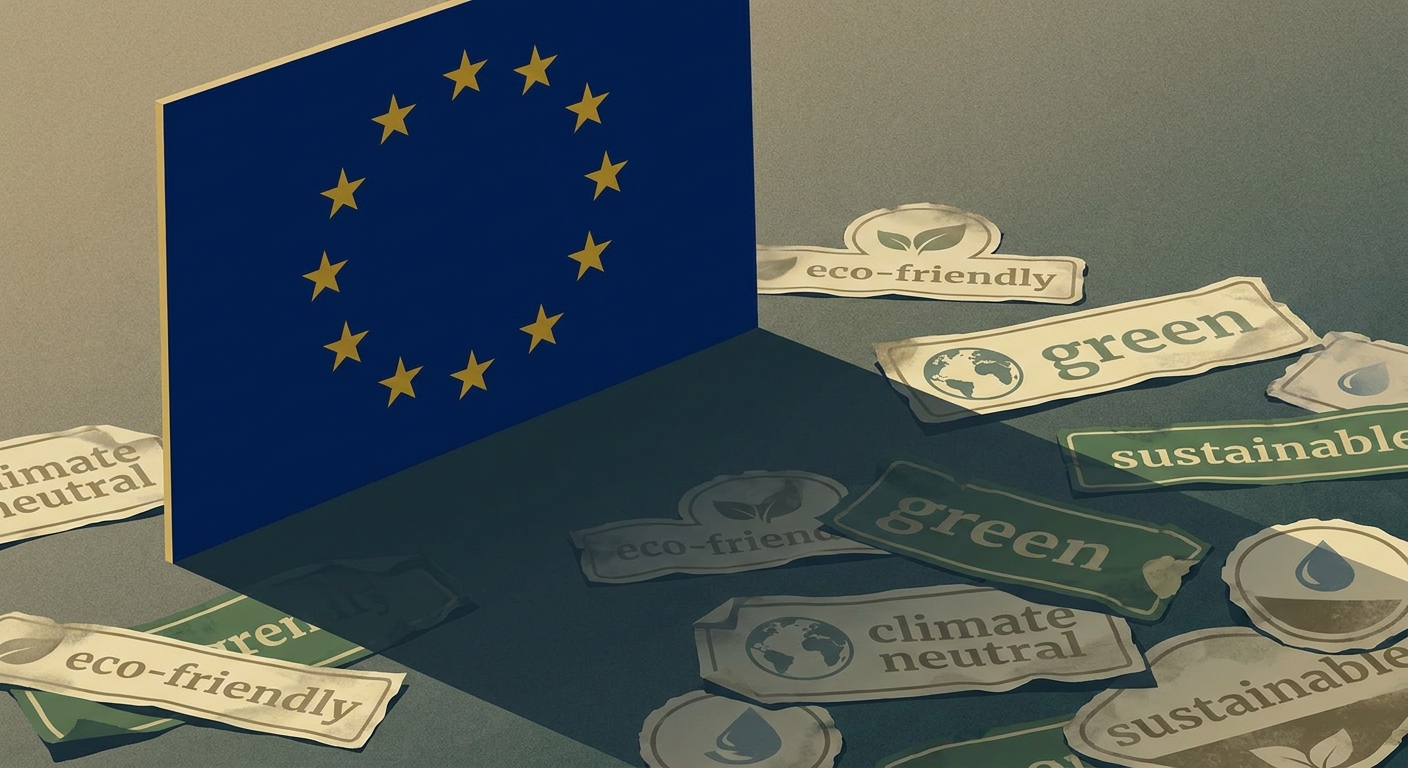
21 Days Until "Eco-Friendly" Becomes Illegal in Europe
On September 27, 2026, six marketing practices that are legal today become prohibited commercial practices across all 27 EU member states. There is no transition period. Claims that were acceptable on September 26 may trigger enforcement action on September 27.
The cause: Directive (EU) 2024/825, officially titled the Empowering Consumers for the Green Transition Directive — known in compliance circles as EmpCo. It amends the Unfair Commercial Practices Directive to create the EU’s most aggressive anti-greenwashing framework to date.
This is not a consultative proposal. It is adopted, transposed, and enforceable in three weeks.
The Number That Should Keep Brand Managers Awake
Between 2024 and mid-2026, EU and national authorities levied €41.9 million ($48.6M) in greenwashing penalties against fashion and textile companies alone — and that was under the old rules. Shein was hit with a €40 million fine in France for overstating sustainability practices. The Italian competition authority followed with another €1 million against the same company. Walmart paid $3 million for labeling rayon as “bamboo.”
Those cases were prosecuted under general consumer-protection statutes — ad hoc, slow, and arguable. EmpCo replaces argument with a checklist. Six practices are now blacklisted. If your marketing matches one, you are in violation. Period.
The Six Banned Practices
EmpCo adds these to Annex I of the Unfair Commercial Practices Directive — the “blacklist” of practices considered unfair in all circumstances, meaning no balancing test, no “but we meant well” defense:
1. Generic Environmental Claims Without Recognised Performance
Terms like “eco-friendly,” “green,” “sustainable,” “climate-friendly,” “biodegradable,” or “responsible” are banned unless the trader can demonstrate recognised excellent environmental performance relevant to the claim. The key word is recognised — self-assessed performance does not count.
2. Offset-Based Carbon Neutrality Claims
Claims of “carbon neutral,” “climate neutral,” “CO₂ compensated,” or “net zero” that rely on purchased greenhouse-gas offsets outside the product’s value chain are prohibited. A company can still buy carbon credits. It simply cannot translate that purchase into a consumer-facing neutrality claim on the product or brand. Only actual emissions reductions within the value chain support such claims.
3. Self-Created Eco-Labels
Sustainability badges, logos, trust marks, or scoring systems that are not based on a recognised certification scheme or established by a public authority are banned. The certification scheme must be developed with relevant expert stakeholder input, be transparent, and be verified by an independent authorised third party. Every in-house “Sustainability Score” badge fails this test.
4. Unsubstantiated Future Environmental Commitments
Pledges like “carbon neutral by 2030” or “100% sustainable materials by 2028” are only lawful if backed by a published implementation plan containing measurable time-bound targets, an independently verified monitoring framework, and allocated financial and technological resources. Aspirational press releases no longer count.
5. False Durability Claims
Asserting that a product has a certain lifespan or use intensity when it does not is now a blacklisted practice. This covers any claim about how long a product will last or how many uses it will withstand.
6. Misleading Repairability Representations
Presenting products as repairable when they are not, or failing to disclose design limitations on non-original parts and accessories, is prohibited. Brands must transparently communicate repairability status.
Who Enforces This — and How Hard
National consumer-protection authorities in each of the 27 member states enforce the directive under their existing UCPD frameworks. That means 27 separate enforcement regimes, each with the power to impose:
- Fines of up to 4% of in-country annual turnover — per member state. A brand operating across the EU faces potential exposure in every market where it makes the claim.
- Confiscation of revenues derived from non-compliant marketing.
- Exclusion from public procurement for up to 12 months.
- Mandatory claim removal — labels, packaging, marketing copy, and digital assets.
The UK, while no longer in the EU, has independently moved to grant the CMA direct enforcement authority with fines up to 10% of global turnover. Canada’s Bill C-15 (March 2026) similarly requires “adequate and proper testing” for environmental product claims. The regulatory direction is global.
The Certification Survival Test
The directive creates a hard binary: claims backed by independent, third-party-verified certification survive. Everything else is suspect.
This is already reshaping the certification landscape. OEKO-TEX announced a comprehensive governance overhaul in direct response to EmpCo — converting from a GmbH to a public limited company (AG), establishing an Independence Council, creating an anonymous whistleblowing system, and formally separating standard-setting from conformity assessment. The reorganisation aligns with ISO/IEC 17065 accreditation standards.
“The reforms aim to reinforce independence and enable consumer protection through verifiable trust in sustainability labeling.”
— Dr. Alfred J. Beerli, CEO, OEKO-TEX
If the world’s most established textile testing body is restructuring its entire corporate governance to meet these requirements, that signals how seriously the industry’s infrastructure is taking September 27.
What Actually Survives
The directive does not ban all environmental marketing. It bans unsupported environmental marketing. What survives:
- Specific, measurable claims tied to verified attributes. “30% recycled content (certified by [named body])” remains lawful. “Made with recycled materials” does not, unless the percentage and certifier are specified.
- Claims backed by recognised certification schemes. OEKO-TEX STANDARD 100, GOTS, EU Ecolabel, and similar third-party-verified certifications remain compliant — precisely because they meet the independence and verification requirements.
- Instrument-verified performance data. “Formaldehyde-free (blind ATR-FTIR tested, ≤16 ppm detection limit)” is a factual, verifiable, instrument-based claim. It is the opposite of what EmpCo targets.
- Regulatory compliance statements. “Meets REACH Restriction 77 formaldehyde limits” is a factual statement about compliance with a specific regulation.
The pattern is clear: survive September 27 by replacing adjectives with data.
The Convergence No One Is Talking About
EmpCo is not arriving in isolation. Three regulatory deadlines are converging within six weeks:
- September 15, 2026 — Minnesota’s PFAS-in-products disclosure deadline. Manufacturers of PFAS-containing products sold in MN must disclose to the Minnesota Pollution Control Agency and pay an $800 filing fee. Extensions to December 14 available.
- September 27, 2026 — EU EmpCo takes effect (this article).
- October 10, 2026 — EU REACH Annex XVII Entry 79 caps PFHxA and its salts at 25 ppb in consumer textiles and footwear. Non-clothing textiles follow October 2027.
Brands exporting to the EU face a September–October compliance cliff: they cannot market textiles with unsubstantiated environmental claims (EmpCo) and those textiles must meet measurable PFAS thresholds (PFHxA cap). The brands that have both independent testing infrastructure and certified performance data are the ones that clear both hurdles.
How CAGE approaches this
CAGE’s approach — blind ATR-FTIR testing, instrument-verified performance claims, and independent third-party certification — was designed for exactly this regulatory environment. Every claim on the CAGE platform is backed by measurable data with named methods and detection limits, not adjectives. How blind testing works →
What This Means for Manufacturers
Action items before September 27:
- Audit every consumer-facing environmental claim — packaging, labels, website copy, digital ads, social media, point-of-sale materials. Flag any that rely on generic adjectives (“eco,” “green,” “clean,” “natural”) or offset-based neutrality claims.
- Identify which claims are backed by independent certification. If a claim references an in-house scoring system or self-created badge, it is non-compliant. Replace it with a recognised third-party certification or remove it.
- Replace adjectives with data. Convert “formaldehyde-free” into “formaldehyde ≤16 ppm (ATR-FTIR, Method X).” Convert “PFAS-free” into “total fluorine ≤[limit] ppb (Method Y, Lab Z).” Instrument-verified, specific claims survive.
- Review future commitments. Any “by 2030” pledge now requires a published implementation plan with measurable targets and independent monitoring. If it’s a press release without a plan, withdraw it or publish the plan.
- Brief your marketing team. The compliance exposure is in marketing execution, not R&D. Copywriters and social media managers need to understand the new lines.
The Bottom Line
September 27 does not end environmental marketing. It ends lazy environmental marketing. The brands that invested in independent testing, third-party certification, and instrument-verified performance claims are about to have the regulatory environment validate their approach. The brands that relied on adjectives and self-created badges have 21 days to fix it.
The question is not whether your products are good. The question is whether you can prove it — with data, not adjectives.
Sources
- Directive (EU) 2024/825 — Official Journal of the European Union (full text)
- Regonance: EU green claims rules — what changes on September 27, 2026
- Enterprise Ireland: Empowering Consumers for the Green Transition
- Cradle to Cradle: What EmpCo means for environmental claims
- Just Style: OEKO-TEX overhauls governance for EU greenwashing laws
- Ecotextile News: OEKO-TEX shapes up for new EU rules
- Apex Fashion Lab: Greenwashing in Fashion — €41.9M in fines
- Compliance Cart: The Shein greenwashing fine
- White & Case: Greenwashing risk and the fashion industry
- Carbonfact: EmpCo Directive for Fashion